Sub-Zero serviceFreezer columns and drawers
A Sub-Zero freezer that won't hold zero: what to save, what to fix
Zero degrees Fahrenheit is home base for a Sub-Zero freezer. When the reading wanders, the first job is protecting what is inside; the second is finding out why it drifted. Naperville Refrigeration Experts handles both for owners in Naperville and nearby DuPage towns, for a $89 call-out that later comes off the repair bill.
Rated 4.9 of 5 · 287 customer reviews About these ratings
Answer 1 of 3
My Sub-Zero freezer is not freezing. What should I do first?
Shut the door and leave it shut. Make sure the display is lit, the breaker has not tripped and the setpoint still reads 0°F. Put a thermometer between packages and read it. If it shows above 10°F, call a technician now and keep the door closed while you wait.
The clock on a stalled freezer
These markers come from general food-safety guidance for a closed freezer. They describe the food, not how quickly a technician can arrive.
-
As soon as you notice
Read the temperature between two packages, not on the door shelf. Write down the number and the time, then close the door. Every opening lets in warm, damp kitchen air.
-
Until help is at the door
Keep traffic out of the freezer. If the fresh-food side shares the cabinet and is still cold, leave it alone too; a closed refrigerator only stays safe for about four hours without cooling.
-
Above 10°F
Treat this as urgent. Call, and if you have a second freezer or a cooler with plenty of ice, move the most valuable items first: meat, fish, anything you would hate to lose.
-
Around 48 hours, door shut
That is roughly how long a full, closed freezer keeps food frozen with no cooling at all. A half-empty freezer gives you less, because there is less frozen mass holding the cold.
-
When the technician arrives
The food gets assessed alongside the appliance: what is still hard-frozen, what has softened, and whether the unit can be brought back today or the food should stay somewhere else.
-
After the repair
The freezer has to pull down toward 0°F before the job is called finished. Items that still carry ice crystals, or stayed at 40°F or colder, can generally go back in under USDA guidance.
Freezer warning signs, decoded
-
Observation Ice cream turns soft and meat gives under a thumb
Likely cause The freezer system is losing ground: a dirty condenser, a stalled fan, a frosted evaporator, a failing sensor or control, or less often a sealed-system fault
-
Observation A thick white coat on the rear wall that grows back after you clear it
Likely cause The automatic defrost is not completing, so the heater, the defrost sensor or the timing logic on the control board is next in line for testing
-
Observation Snowy crystals on packages near the front and a gasket that looks wavy
Likely cause Humid air leaking in around the door, from a worn gasket, a misaligned hinge or a drawer stopping a hair short of shut
-
Observation A louder compressor, or clicking right at startup that repeats
Likely cause A start component struggling, a fan nicking a ridge of ice, or a compressor working against heat it cannot reject Read more: Noises and vibration
-
Observation The display swings between good and poor readings through the day
Likely cause A sensor or control giving inconsistent signals, or a defrost cycle that runs too long; the pattern of the swings helps separate the two
-
Observation No ice in the bin while the freezer itself feels fine
Likely cause Usually the ice maker, its water supply or the filter, rather than the freezer system Read more: Ice maker repair
Answer 2 of 3
What causes heavy frost inside a Sub-Zero freezer?
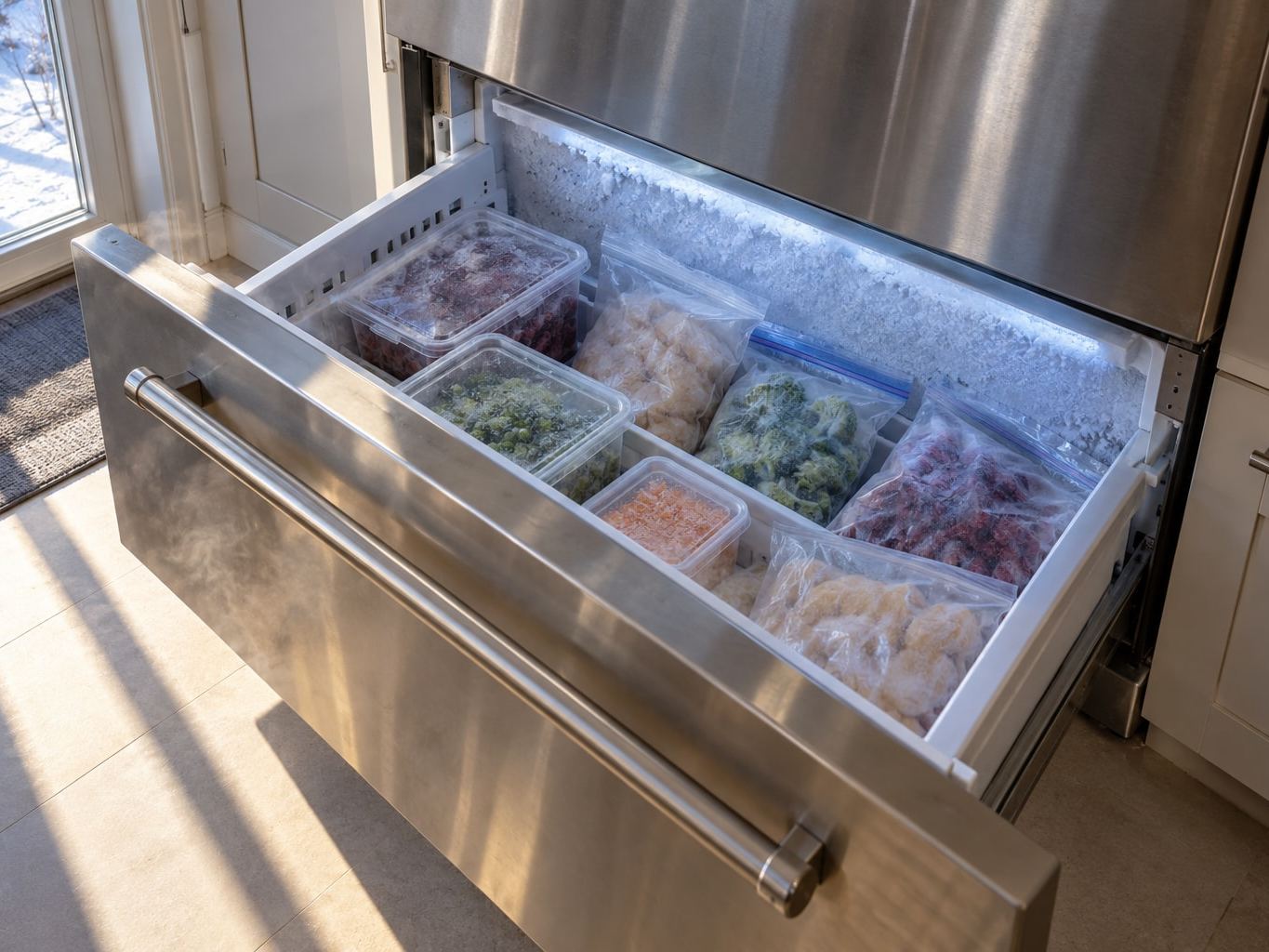
There are two usual sources. Either the automatic defrost is no longer clearing the evaporator, which points to the heater, the defrost sensor or the control, or damp air is getting past a worn gasket or a door that stays slightly open. Frost on the back wall suggests the first; crystals near the door suggest the second.
Defrost frost or door frost: telling them apart
Both look like too much ice, but they come from different places and need different repairs. Here is how a technician reads the pattern.
Frost from a defrost fault
- An even white layer on the rear wall or over the evaporator cover
- It returns steadily after a manual defrost
- Cooling fades as the coil gets buried and air stops moving
- The fan may sound muffled or scrape against ice
- Points to the defrost heater, its sensor or the control
Frost from the door or gasket
- Crystals collect on the front packages and along the opening
- Worse on humid summer days and after busy kitchen evenings
- A gap you can see or feel somewhere along the gasket
- A drawer that bounces back open or a door hanging low on its hinges
- Points to the gasket, the hinge adjustment or how the cabinet sits
VerdictEither way, do not chip ice with a knife or melt it with a heat gun. Tubing and liners sit right behind that frost, and a puncture turns a modest repair into a sealed-system job.
Quick checks worth doing first
No tools needed. Sometimes one of these is the whole fix; otherwise your notes shorten the visit.
- The control display is lit and the setpoint has not been nudged away from 0°F.
- The breaker for the freezer circuit is on, not halfway or tripped.
- Nothing inside, like a tall bag or a bin lid, is propping the drawer or door open.
- Shut the door on a strip of paper in several spots. Feel resistance as you slide it free? The seal is gripping there.
- The grille above the unit is not packed with dust or blocked by stored items.
- You have noted the temperature reading and any new sound, with the time you noticed it.
- Water on the floor? Close the valve feeding the unit and dry the area.
Answer 3 of 3
How long does food last in a broken freezer with the door kept closed?
A full freezer keeps food frozen for about 48 hours with the door shut and no cooling; a half-full one, noticeably less. The fresh-food side lasts roughly four hours. Leave both doors alone, check the temperature once, and food with ice crystals or at 40°F or below can generally be refrozen.
Freezer reading above 10°F? Pick up the phone and keep the door shut
Someone picks up 24/7; appointments run 8 AM–6 PM, seven days. Your $89 call-out covers the freezer and whatever other Sub-Zero appliances you'd like inspected on that trip.
Phone answered 24/7 · house calls 8 AM–6 PM, seven days
What freezer owners ask us
- Should I be cleaning the condenser, and how often?
- Plan on it at least once a year, and twice a year in homes with shedding pets, fresh remodel dust or a kitchen that cooks every night. Dust on that coil traps heat, stretches each compressor run and can be the entire reason a freezer slips behind. Routine cleaning is part of scheduled maintenance.
- Can I unplug the freezer and let it defrost to fix the frost myself?
- A manual defrost can clear the ice for a while, and it tells you something: if the frost comes back on the rear wall, a defrost part has likely failed and will keep failing. Move the food somewhere cold first, never use sharp tools or heat guns, and mop up the meltwater as it comes.
- The fridge side is acting up as well. Can one appointment cover both?
- It can. You pay the trip charge once for the visit, regardless of how many appliances get examined, so the fresh-food side and any other Sub-Zero in the house fit into one appointment. Read about refrigerator repair for how the fresh-food system is tested.
- When do I find out what the repair will cost?
- Right after the inspection. The technician tells you which part failed, what the work involves and the exact figure, then waits for your yes. The $89 call-out is deducted from that total. The pricing page explains the approach, and the contact page has every way to reach us; for a freezer full of food that is warming quickly, see the emergency steps.